
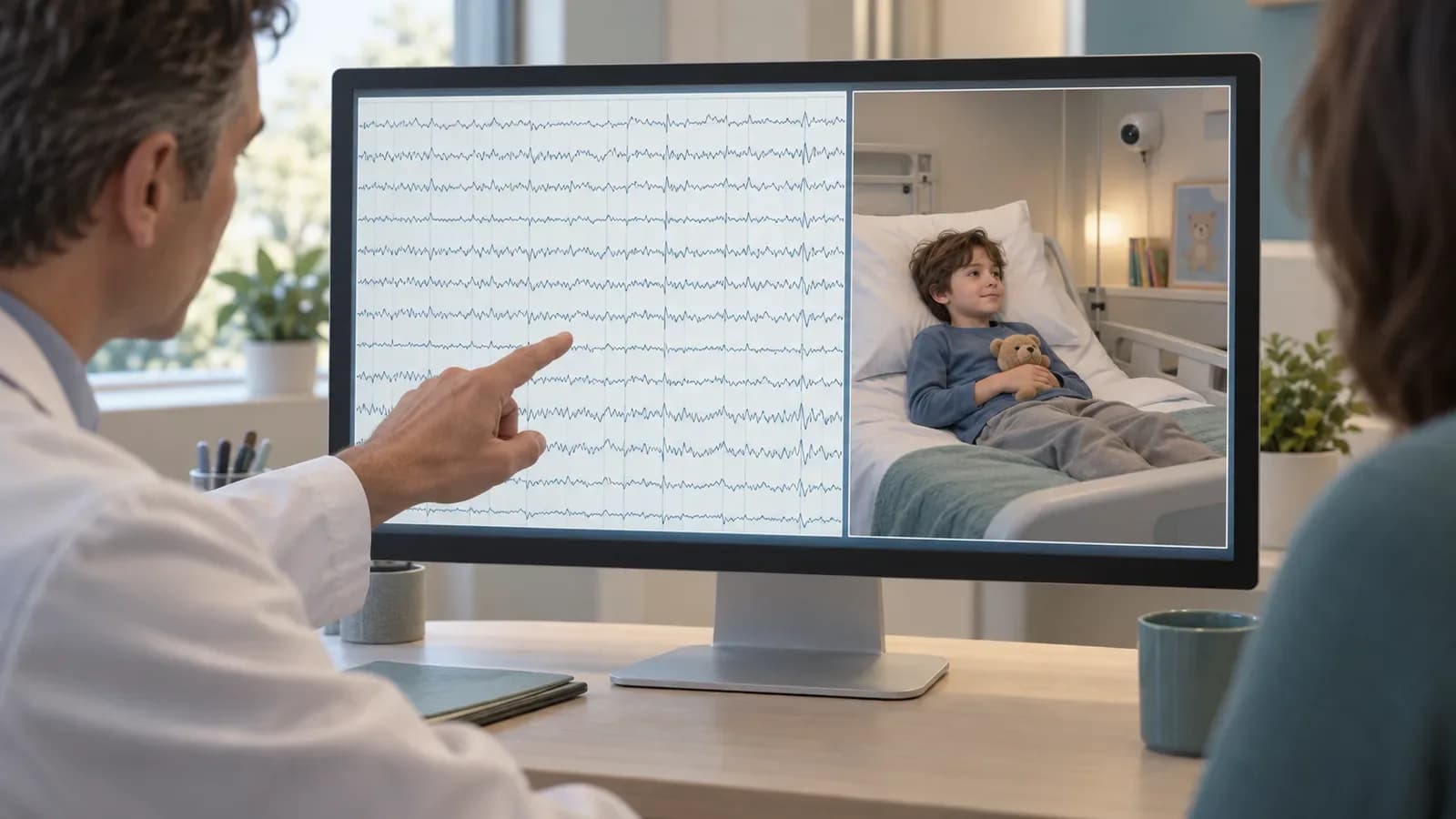
Video EEG combines brain activity recordings with video; the illustration shows the principle of comparison.
An epilepsy diagnosis alone does not establish whether a child can travel for rehabilitation. The decision needs information about seizures, current treatment and the aims of the proposed sessions. Saying that epilepsy is “controlled”, or providing one EEG report, does not replace this assessment. Agree the plan with the clinician managing the epilepsy and the receiving team before travelling.
Is video EEG needed before rehabilitation?
An EEG records the brain’s electrical activity. Video EEG combines that recording with video of the child’s behaviour and movements, helping clinicians assess particular events. It is not a universal clearance for every procedure. Great Ormond Street Hospital explains this use of video telemetry.
A useful question for the neurologist is: what needs clarifying, and would the result change the care plan? The specialist decides whether further information is needed, which recording is appropriate and whether existing results can be used. Do not choose the monitoring duration or deprive a child of sleep to prepare for a recording on your own.
A normal EEG does not exclude epilepsy, as NICE guidance states. A promise to “do an EEG and clear the child for the course” therefore oversimplifies the decision. The events themselves and the medical history also matter.
If a test is proposed after arrival in China, establish beforehand whether the required format is available on the intended dates, who orders and interprets it, and how the treating neurologist will receive the report. An “EEG” entry on a service list does not settle these questions.
What to explain about seizures and medicines
The published epilepsy information for Yuncheng People’s Hospital lists the seizure type and frequency, date of the last event, medicine names and doses, and an EEG report if available as information for the preliminary consultation. Prepare these details alongside the neurologist’s report.
Describe what happens rather than relying on “stable”. Explain when the last familiar event occurred, whether its pattern has changed, and what the clinician advised if it happens again. If the family keeps a seizure diary, discuss it at the consultation. Do not try to classify a new event from internet descriptions.
The medicine list should reflect current prescriptions, including changes since the last discharge report. The NHS advises against missing doses or changing treatment without medical advice. Starting rehabilitation is not a reason to stop an anti-seizure medicine. Discuss dosing arrangements during travel and across time zones in advance.
Can a child with epilepsy have physical therapy?
Discuss a specific session: what the child will do, what support is needed and how supervision will work. “Physical therapy” covers different activities and settings; the label alone does not establish that a whole programme is suitable.
Ask how the team will account for the child’s seizure pattern and other limitations. Discuss water activities, heights and equipment where a sudden loss of control could cause injury separately. The NHS highlights safety considerations for swimming and other activities; this does not mean the same restriction on movement applies to everyone.
Avoid creating a universal list of permitted and prohibited procedures from another child’s course. For each proposed procedure, ask the clinician why it is included, which restrictions apply now and what would prompt a review. When a child also has cerebral palsy, distinguish rehabilitation goals from seizure control: a change in a motor skill does not establish a change in epilepsy.
Who responds if the child’s condition changes?
Before the course begins, the family needs a clear plan for responding to a seizure. The NHS describes an individual care plan setting out what family members should do. Share the existing plan with the receiving team and establish how it will be followed during sessions.
Ask four practical questions:
- Who knows the child’s seizure pattern and current prescriptions?
- Whom does a staff member contact if the child’s condition changes?
- How is urgent medical assistance arranged?
- How will the family inform the treating neurologist about new events and changes to the programme?
Being a general hospital does not replace answers about the particular department, session times and responsible staff. An interpreter can support communication, but clinical decisions need to remain with the professionals.
When should the travel plan be reconsidered first?
Tell the clinician about new events or a seizure returning after a long seizure-free period before continuing to plan the course. The NHS advises seeking medical help when seizures return after a long period without them. An earlier agreement cannot automatically be applied to a changed situation.
A prolonged seizure or repeated seizures without the usual recovery requires urgent help according to the individual plan and local arrangements, rather than waiting for a travel coordinator’s reply. This article does not replace the clinician’s instructions for that situation.
Ask about a case review
If you are considering Yuncheng People’s Hospital, begin by asking how to submit the neurologist’s report, seizure information, current prescriptions and existing EEG results. Establish whether the case can be reviewed and what further questions the clinician has before booking a course. This article does not confirm admission for a particular child, require video EEG for everyone or confirm local availability of a particular test.